
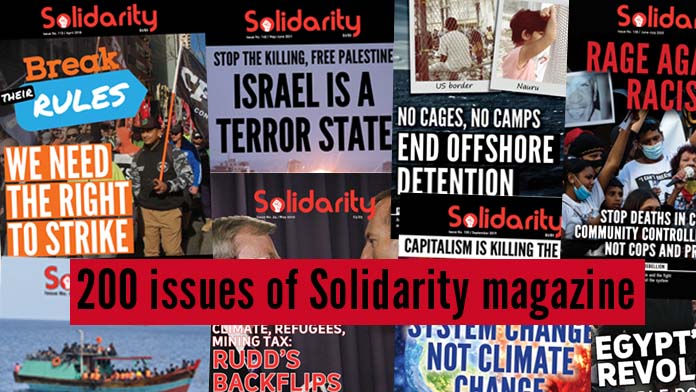
To mark 200 issues of Solidarity we look at key articles, issues and covers that have appeared since our first issue
Labor in power
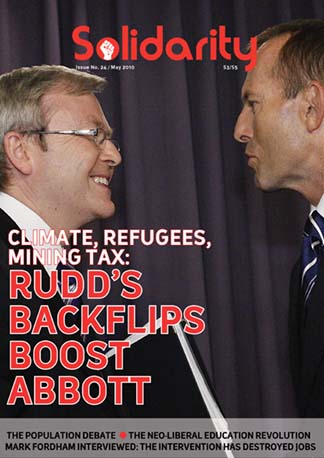
Solidarity was launched in 2008 just after Kevin Rudd’s Labor government took power.
Lessons from Labor’s last time in power summed up how he dashed the hopes of a break from the legacy of John Howard’s Liberal government:
“Kevin Rudd won office on a massive 5.44 per cent swing—even unseating John Howard in Bennelong. On the back of Rudd’s ratification of the Kyoto Protocol and apology to the Stolen Generations, his approval rating soared to 70 per cent.
“But it all ended in tears. Labor’s problems stem from their commitment to managing capitalism.
“Rudd and Gillard continually delivered policies tailored to the needs of big business. Even when the Global Financial Crisis struck in 2008, Rudd stimulated the economy and took the budget into deficit as he talked about “saving capitalism from itself”. Mostly Rudd was concerned to save capitalism. The Treasurer, Wayne Swan, as early as 2010 was back to promising Labor would deliver budget surpluses. This meant making cuts welfare spending and education.
“As Labor crashed in the polls and the Liberals attacked, Labor’s response was to move to the right.”
We have also published a series on Australian Labor Party history, covering the historic splits in the party during the First World War over conscription and in the 1950s, Labor’s wage cuts and austerity in the Great Depression, Whitlam, and Hawke and Keating.
More recently we’ve looked at why Albanese is so useless and right-wing. Our most recent articles on Labor can be found here.
Unions and the right to strike
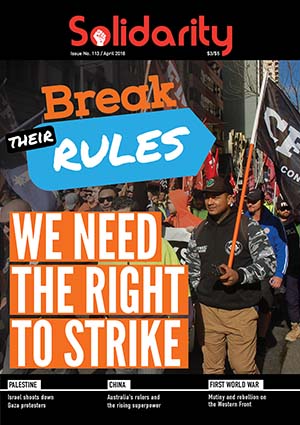
We’ve reported on numerous strikes and union struggles such as the campaign in 2012 that saw Nurses defy the law to defend the health system and jobs in Victoria, staging “rolling stoppages involving over 1000 nurses, midwives and mental health nurses across 15 hospitals” that “showed how to take ‘illegal’ strike action in spite of the threat of fines from Fair Work Australia of $6600 against individual nurses and up to $33,000 against the union for breaching Federal Court orders”.
And in 2018 we covered how 120,000 stop work in Melbourne to Change the Rules as“Around 120,000 workers took over the streets of Melbourne on 9 May in an awesome display of working class power … launching the Change the Rules campaign.”
Yet “the emphasis was on preparing for an electoral campaign to get rid of Malcolm Turnbull’s Liberal government.”
But as we argued in Enterprise Bargaining and the UnFair Work Act “The system of Enterprise Bargaining restricting lawful strike action to bargaining periods is at the core of laws that have removed the right to strike” yet Labor governments have maintained “the barring of industrial action outside protected periods”.
We’ve also looked at lessons from working class history, from the general strike that smashed the anti-union penal powers in 1969, the great coal lockout of 1929 to the 1998 MUA dispute and many others.
Indigenous rights
In 2007, Liberal Prime Minister John Howard launched the Northern Territory Intervention. Solidarity reported on the resistance from Indigenous communities and discussed in The NT intervention and the new politics of assimilation how, “The Intervention is designed to dispossess, to push people off their lands and into towns” as “the most extreme manifestation of the assimilationist agenda” pursued throughout Howard’s time in power.
In
Some of our best coverage was collected in a pamphlet in 2012.
Then “Shamefully, the Rudd Labor government, elected in late 2007, wholeheartedly embraced the Intervention” in ongoing analysis such as After 15 years of racism—chance to tear out the NT Intervention by the roots in 2022.
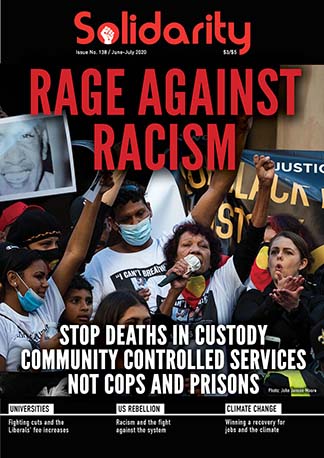
As the Black Lives Matter protests hit the streets in 2020 we examined how Racist government policies fuel deaths in custody.
More recently we explained How the plan for a token advisory Voice was hatched that offered no real rights and why After the Voice’s defeat, we need the politics of protest and how Albanese fails to act as deaths in custody and imprisonment surge.
And we have covered the history of Indigenous struggle, with a series on figures like William Cooper, Bill Ferguson, Pearl Gibbs and Chicka Dixon as well as The Gurindji strike: Unions and the fight for land rights.
Refugees
Brutal racist policies against refugees have been a shameful feature of Australian politics since John Howard “dramatically expanded detention centres—opening Woomera in November 1999” and then launched the Pacific Solution following the Tampa crisis in 2001 as we explained in a history of How the refugee movement changed public opinion last time in 2011.

Labor was already trying to outdo the Liberals in attacking refugees, but as we argued in 2013 Rudd’s PNG deal saw, “Labor’s plan to shut out asylum seekers completely and finally fulfil the project started by John Howard and the Immigration department in 2001—to create a Fortress Australia that denies asylum to anyone arriving by boat.”
This situation is still with us as Labor’s refugee shame as Liberals claim ‘we are running the Immigration system’ argued last year as Albanese passed sweeping new deportation laws:
“Not for the first time, Labor has purposely sacrificed principles on the altar of electoral opportunism.
“Since Labor was elected asylum boats have been intercepted and turned around at sea. More than 100 asylum seekers have been sent to Nauru, with no prospects of resettlement.”
But as Refugees and resistance in detention explained, protests have also won gains, such as in 2016 when “news leaked that Lady Cilento Hospital staff had refused to discharge baby Asha to possible deportation to Nauru” and “refugee activists quickly organised a solidarity vigil and picket” as part of the Let Them Stay campaign that stopped refugees being sent back to Nauru and Manus Island.
Another pamphlet on refugees brought together some of our best articles on the issue.
Palestine and imperialism
In our first issue in March 2008 we reported that “Israel has unleashed a new murderous offensive against Palestinians in the Gaza strip” as its “blockade denies the entrance of basic goods into Gaza”.
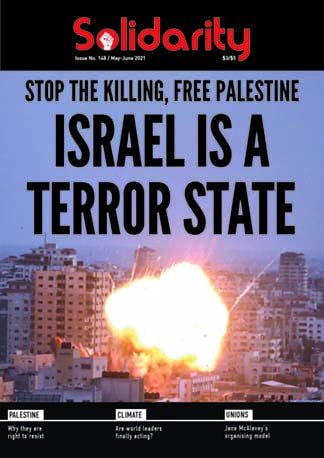
When Israel began its genocide in October 2023 we wrote, “This war didn’t begin when Hamas sent rockets and soldiers over the border. Israel has been waging war against the whole civilian population of Gaza almost continuously since 2007.
“From its foundation it has relied on the support of Western imperialist powers to seize and occupy Palestinian land, playing a key role imposing US control of the surrounding Arab states in return.”
In Free Palestine—why we say by any means necessary we argued that, “The resistance by Palestinians against the racist Israeli terror state is wholly justified. All the deaths, horrors and destruction—all of them—are rooted in violent Israeli occupation and dispossession.”
Shortly after Revolution in the Arab world the key to Palestinian liberation argued that, “In 2019 hundreds of thousands in Lebanon called for revolution, in protests sparked by austerity measures and economic collapse. The same month mass protests took to the streets of Iraq against corruption and poverty.
“The real hope for the Palestinians lies in mass struggle by workers and the poor all across the Middle East.”
Climate change
Despite evermore urgent warnings of catastrophe, world leaders have comprehensively failed to act on climate change. “The action needed means fighting the logic of capitalism and profit,” argued Capitalism vs the climate: Why we need system change.
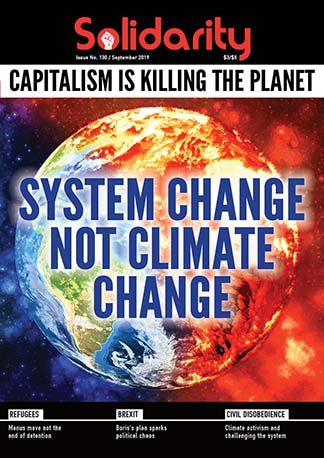
In 2011 Labor and The Greens introduced a carbon tax but as we put it, “Despite talk of making the polluters pay, the carbon tax was designed so that companies would pass the cost on through increasing electricity prices.” This was a gift to Tony Abbott and the Liberals, who declared that the tax would raise power prices and damage workers’ cost of living, promising to axe it.”
“The climate movement’s support for the tax cut it off from wider layers of workers,” we wrote in Lessons from the last climate movement.
As the Climate Strike movement rose, the 2019 election result “was a heavy blow that left many supporters of climate action reeling”, with the Liberals returned to power after a campaign that won votes in mining areas opposing climate action.
As we argued in Election result shows why climate action must mean a fight for jobs, “Only a pro-jobs climate movement that draws in significant working class support can succeed. The demand for direct government investment in 100 per cent renewable energy by 2030 has to be raised alongside the call for a just transition.
“This means guaranteed re-training and new, public sector jobs for mining workers with no reduction in pay and conditions.”