

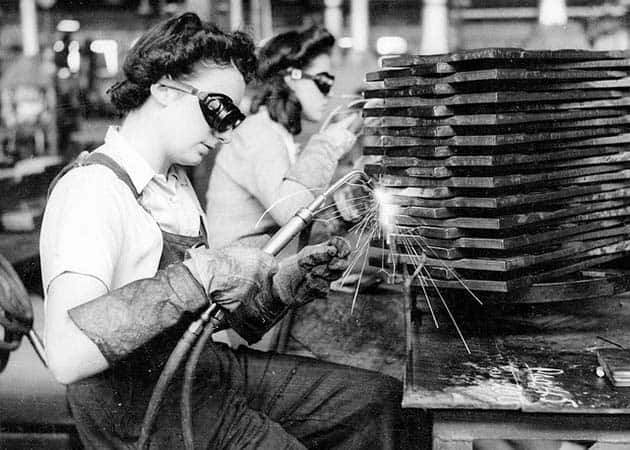
Joy Qiao explains how women challenged sexism and fought to demand equal pay after joining the workforce in large numbers during the Second World War
Too few people know how women workers in Australian munitions industries during the Second World War launched a heroic strike wave which saw them win 90 per cent of the male pay rate.
Their victory came against the odds of a deeply sexist society and union bureaucracy and nationalist pressure to sacrifice for the war effort.
We’re told about how women “stepped up” during the war—but they didn’t just quietly accept their role. Instead, they organised and challenged decades of gender division and built a confidence to demand equal wages.
Their militancy didn’t just win immediate gains, it also showed something much bigger: that confidence is built through struggle and that workers—even in the middle of a war—have real power.
Living wage
To understand why this was so significant, it’s important to look at how work was organised before the war. The 1907 Harvester agreement established the concept of a “living wage”, enough for a male worker and his wife and family to live on. This enshrined the idea that the real place for women was in the home.
In reality, families could not survive on the so-called “living wage”. So in the first half of the 20th century there was a slow but steady increase in women working. As early as 1927, about half of all factory workers in Australia were female.
Yet labour was still strictly divided along gender lines. Men were seen as the “real workers”, skilled and paid a wage that was supposed to support a family.
Women’s work was labelled “unskilled” even when it clearly wasn’t. Moreover, they were paid often just a fraction of the male wage and seen as temporary workers or secondary earners.
This wasn’t just a cultural attitude. The wage structure itself enforced inequality. The idea of the “living wage” meant that men’s wages were prioritised, while women’s labour was systematically undervalued. This division kept wages down overall.
So before the war, the idea of women working in heavy industry, especially weapon production, was almost unthinkable. But then the war began in 1939 and suddenly, everything shifted.
With so many men sent off to fight, there was a massive labour shortage and the need to ramp up production of military goods.
The RAAF was the first to introduce women, to fill an acute shortage of telegraph operators. Then factories began to take women workers. They did jobs like filling bombs and shells, assembling aircrafts and parts for navy vessels, metal work and building gun components.
The mainstream narrative about women and “suitable” labour changed overnight. Now, women were told it was their patriotic duty to work. Posters, propaganda, and public messaging reinforced this idea.
Women were urged to take a “victory job”. Newsreels shown in cinemas showed cheerful “girls” enjoying the freedom of life in the Women’s Land Army or “doing their bit” in the factories.
Popular women’s magazines like the Australian Women’s Weekly printed features promoting women’s war work. These articles supported the new, expanded roles for women but also reassured their readers of the enduring femininity of such women workers.
One propaganda poster said, “What does it matter if the furniture does get a bit dusty? Or the floors a bit dull? Come on housewives, take a victory job. You’ll find it no harder than your house job. Easier perhaps. In fact, many war production factories, with their spic and span canteens, bright music and carefully planned rest breaks are more fun to work in than any house.”
Some women were effectively industrial conscripts. The government established a Manpower Directorate in early 1942. In January 1943 its powers were extended to women. All childless women aged between 18 and 45 were required to register. Women who refused appointments were threatened with imprisonment.
Sexist resistance
There was still sexist resistance to women’s role in the war. Unions feared competition for men’s jobs from low-paid female workers, employers in “male” industries doubted that women could perform heavy tasks or tasks requiring high levels of skill, while bosses in “female” industries feared competition for workers and the resulting pressure on wages.
On the one hand women were being told that they were essential for the war effort but on the other were still being treated as inferior workers. The ruling class needed women’s labour to sustain the war effort. But they also wanted to preserve the existing social order. So the shift in ideology was very controlled.
Women were encouraged to work but only for the duration of the war, and without fundamentally challenging the idea that men’s work was more valuable. This meant that they were still paid only 60 to 75 per cent of the male wage.
In addition, the conditions they were working under were brutal. Elly Blackshaw, who worked at the Maribyrnong explosives factory in Melbourne as a “filler”, said, “The temperature in the factory was maintained at a steady (32C) to keep the powder dry, so we sweltered in summer. The powder I held in my hands was enough to blow up a ship. Almost every day someone was hurt, some were blown to pieces, building and all.”
Women were producing something essential as part of a collective labour process. They could see how important their work was and that began to change how they saw themselves. This growing confidence led to a wave of militant strikes.
The Small Arms Ammunition Factory in Footscray, Melbourne, was a pre-war employer of women so the pay was lower than in other munitions factories where the Women’s Employment Board (WEB) had set the rate.
Several thousand male and female workers held a stopwork meeting in early 1943, demanding the 90 per cent rate for females. More than 2000 women from other government factories joined them on strike.
These strikes were without success. But they did succeed at Simmonds Aerocessories in South Melbourne. Here Simmonds refused to pay the rate awarded by the WEB. So 132 women sheet metal workers struck for over four months. The case went as far as the High Court before the company capitulated and paid the 90 per cent rate.
When Amalgamated Wireless Australia in Ashfield, Sydney, refused to pay a pay rise granted by the WEB, 150 women in the aircraft assembly section joined the Amalgamated Engineers Union (AEU).
When the Board decided that only 75 per cent of them were entitled to the WEB rate, a three-week strike followed.
Labour historian Daphne Gollan wrote that, “In NSW, during the 20 months ending August 1944, there were 1432 industrial disputes involving 588,951 workers and resulting in a loss of one and a half million man-days—or as was more frequently the case, woman days.”
When a Sydney company, Richard Hughes, refused to pay the WEB rate, the case dragged through the courts for over six months. By June 1944 it had become obvious to the workers that they were getting nowhere. A strike and lockout led quickly to a settlement and back pay.
Unpatriotic
Employers were particularly obsessed about keeping down women’s wages. This was despite the government agreeing to foot the bill for all manufacturing costs during the war, including any wage rises. They wanted to remind women that their work was a temporary evil for the war.
Striking during wartime wasn’t a small thing. Strikes could be framed as unpatriotic, or even as undermining the war effort. But despite this, women still took action.
When women metalworkers at the Richard Hughes factory in Sydney went on strike to get the award wage of 90 per cent of the male rate, the Communist union secretary urged them to return to work by invoking “the boys in the trenches”. The women angrily retorted, “We know all about our boys in the trenches … they’re our husbands and sons.” They won an award payment.
In some instances, men supported women’s demands. They recognised that wage inequality weakened the entire working class.
But where unions would not lead action, women were prepared to act themselves. Young women workers at the Berlei factory in Sydney used the technique of the classroom, passing notes from machine to machine to elect representatives and agree to a stopwork.
This militancy had a broader context. By the later years of the war, there was increasing unrest across different sectors. One example is the Balmain Docks dispute 1945, which shows how workers more generally were becoming more willing to take action.
Taking action
There are two lessons from all this. The first is that gender divisions weren’t natural, they were enforced. And when those divisions were challenged, workers became stronger.
Secondly, there is self-activity. Change didn’t come from above. It came from women organising themselves—taking action and forcing change. These women didn’t enter the factories as confident militants. Their confidence developed through struggle.
Unfortunately, the lessons of their strikes were not generalised in a broader and more conscious effort to destroy sex roles and pay inequality. Many of the gains were lost when the war ended. So the struggle continues.
Today’s situation is obviously different but there are still some useful parallels. Australia is building an arms industry in preparation for war with China. Weapons have to be built by workers in factories.
So the same question still is, who really has the power? The story of women in munitions shows that even in a highly controlled wartime system, workers were able to organise to resist.